I got new glasses last week. (Last week? Really? Seems like I've had them forever already.) I'm not sure what I think of them yet. I like seeing the world clearly again, but they don't look quite as cool. According to (*ahem*) "a certain member of my household" (*ahem*) they are the mom jeans of glasses. But then, my last pair was a super spiffy frameless kind that just didn't hold up with a toddler in the house. What do you think?
If you follow me on Twitter, you may already be privy to the saga of the glasses. It was told in three parts, on three different days, It occurred to me that, silly as it was, it was an excellent model of three act structure.
Act 1: Set Up
This is our introduction. We have a protagonist (me! *waves*) and an inciting incident (acquiring new glasses). We also have a small obstacle introduced with the inciting incident that must be overcome (adjusting to the depth perception).
[Apparently this was from the astigmatism, and was it ever strange! I drove home with the old, broken glasses because I couldn't bear to look long distance for more than an instant.]
Act 2: Confrontation
As you can see, the first obstacle was overcome. But right on the heels of victory came a new, more difficult challenge: the glasses didn't fit! (Seriously, it was so annoying to have them falling off my face every time I bent my head more than 20 degrees.)
I tried to look up options for fixing them myself. Thus I came to the midpoint of my saga: the realization that I could not fix them on my own, and that if I tried I would likely break them(!).
I called the office where I'd gotten the glasses, but they were not open. Disaster upon disaster! What would I do?
Act 3: Resolution
Fortunately, the office opened again at a convenient time the following day. I drove over as soon as they opened, and they quickly assisted me. All was well.
I guess three act structure really does exist in the real world!
Thursday, September 11, 2014
Wednesday, September 3, 2014
Three Random Things
It's been one of those weeks. The boy has strep. Hubby and I have been a bit sick too. So instead of a thoughtful blog post, you get a "three random things" post.
1. I'm currently reading The Golem and the Jinni and it is such a wonderful book. Love the writing, love the history and the research that went into it. It's a rich, beautiful experience.
2. I've started using HabitRPG. Let me know if you're on there. I haven't formed a party or done much of anything yet except gain levels.
3. I've got new glasses to pick up this afternoon! I'm so excited about this. The old ones finally broke beyond repair. (Note that this is not the first time they have broken.) Seeing as I needed a new prescription anyway, this is probably not a terrible thing. Can't wait to see what the world really looks like again!
Have a wonderful week, everyone. And happy new school year to those just starting back this week!
Labels:
Book Recs,
glasses,
HabitRPG,
three random things
Wednesday, August 27, 2014
Ten Books
Ten books that "have stayed with you the longest or have changed you in some way." My friend Eileen tagged me for this on Facebook, and I'm not having an easy time of it picking my ten.
It's sort of like asking me to tell my life story in ten sentences. Birth, marriage, the birth of my son--these are obvious choices. But do I go with my first job or the first time I traveled out of the country? What about that time I danced until my toenails fell off and then kept dancing anyway, or the year I went to the international science fair? You know, come to think of it, birth is kind of an obvious addition to the list... maybe I could get away with cutting it.
That's how I feel picking out ten books, so if I fudge it in a few places, please forgive me.
1. The Lord of the Rings & The Chronicles of Narnia
Why? These are the equivalent of "birth" in the analogy above. I'll never forget my dad reading the Battle of Helm's Deep and shouting "KHAZAD AI-MENU" at the top of his voice. Or how, after my mom read Narnia to me, I pretended my bathroom door could take me there. (The swirls in the wood of the door looked a little like a face.)
These are the books that made me a reader, and while they seem so obvious I wish I could cut them to make more room, I wouldn't really be here without them.
2. Harry Potter
Why? I never fell in love with a fictional world as much as I did with the wizard world. It was a revelation. I wanted to live there. Barring that, I wanted to create other worlds that made people feel the way Harry Potter made me feel. These are the books that made me a writer.
3. Ender's Game
Why? The psychology of it really resonated with me. My first real attempts at writing were very derivative of this book.
4. Watership Down
Why? It's one of the few books that gets better every time I read it. The characters stay with me. (And, I admit, the creepy warren does too.)
5. Howl's Moving Castle
Why? It's the only book I've re-read immediately after reading. I've read a lot of books that made me sad or made me laugh or even a combination of the two. But I never read one as whimsical as this. It fit the mood of my life so perfectly that I wanted to stay in it longer. Plus, Sophie's magic is precisely the sort I always wished for whenever someone asked me what my superpower would be, were I lucky enough to have one.
6. The Sparrow
Why? Perhaps it was because the main character was a linguist, and at the time I was studying linguistics. Perhaps it was the mix of horror and compassion at the end of the book. It hooked me, and then it tasered me in the feels.
7. The Merlin Trilogy
Why? Great series, but there's one particular scene that stands out to me. It digs into the relationship between the two central characters, and with a single sentence BOOM! emotional fallout.
8. Elsewhere
Why? It's one of the few books that actually has a recognizable influence on how I live. Sure, every book changes the mind in some way, but this one made me conscious of the change. It helped me to look at areas of my life where I'm wasting my time and think more critically about them. Also, it had the most bittersweet ending...
9. The Book Thief & Code Name Verity
Why? If you've read them, I don't need to tell you. If you haven't read them, I can't tell you.
10. Un Lun Dun
Why? Because it is funny and clever and doesn't take itself too seriously.
Aaaaand now I want to go back and read all of these again. Oops.
It's sort of like asking me to tell my life story in ten sentences. Birth, marriage, the birth of my son--these are obvious choices. But do I go with my first job or the first time I traveled out of the country? What about that time I danced until my toenails fell off and then kept dancing anyway, or the year I went to the international science fair? You know, come to think of it, birth is kind of an obvious addition to the list... maybe I could get away with cutting it.
That's how I feel picking out ten books, so if I fudge it in a few places, please forgive me.
1. The Lord of the Rings & The Chronicles of Narnia
Why? These are the equivalent of "birth" in the analogy above. I'll never forget my dad reading the Battle of Helm's Deep and shouting "KHAZAD AI-MENU" at the top of his voice. Or how, after my mom read Narnia to me, I pretended my bathroom door could take me there. (The swirls in the wood of the door looked a little like a face.)
These are the books that made me a reader, and while they seem so obvious I wish I could cut them to make more room, I wouldn't really be here without them.
2. Harry Potter
Why? I never fell in love with a fictional world as much as I did with the wizard world. It was a revelation. I wanted to live there. Barring that, I wanted to create other worlds that made people feel the way Harry Potter made me feel. These are the books that made me a writer.
3. Ender's Game
Why? The psychology of it really resonated with me. My first real attempts at writing were very derivative of this book.
4. Watership Down
Why? It's one of the few books that gets better every time I read it. The characters stay with me. (And, I admit, the creepy warren does too.)
5. Howl's Moving Castle
Why? It's the only book I've re-read immediately after reading. I've read a lot of books that made me sad or made me laugh or even a combination of the two. But I never read one as whimsical as this. It fit the mood of my life so perfectly that I wanted to stay in it longer. Plus, Sophie's magic is precisely the sort I always wished for whenever someone asked me what my superpower would be, were I lucky enough to have one.
6. The Sparrow
Why? Perhaps it was because the main character was a linguist, and at the time I was studying linguistics. Perhaps it was the mix of horror and compassion at the end of the book. It hooked me, and then it tasered me in the feels.
7. The Merlin Trilogy
Why? Great series, but there's one particular scene that stands out to me. It digs into the relationship between the two central characters, and with a single sentence BOOM! emotional fallout.
8. Elsewhere
Why? It's one of the few books that actually has a recognizable influence on how I live. Sure, every book changes the mind in some way, but this one made me conscious of the change. It helped me to look at areas of my life where I'm wasting my time and think more critically about them. Also, it had the most bittersweet ending...
9. The Book Thief & Code Name Verity
Why? If you've read them, I don't need to tell you. If you haven't read them, I can't tell you.
10. Un Lun Dun
Why? Because it is funny and clever and doesn't take itself too seriously.
Aaaaand now I want to go back and read all of these again. Oops.
Wednesday, August 20, 2014
A Penny for Your Virus?
How much would you pay for a virus?
Before you answer that, no, in this scenario you are not the villain of a Mission: Impossible flick.
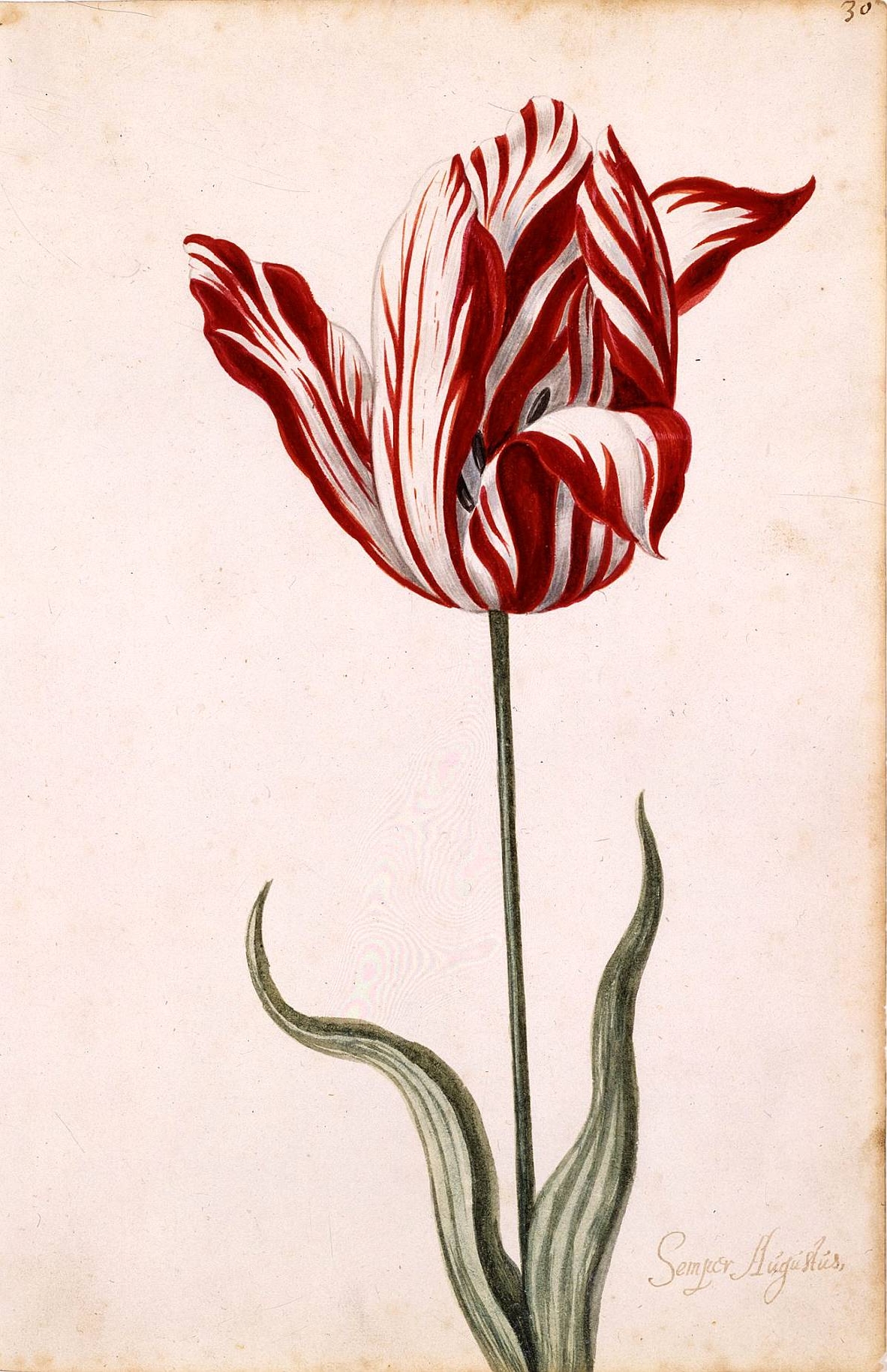
If, instead, you are a 17th century Dutch investor, you might be willing to pay the equivalent of ten years' income. Ten years of hard work just to buy...
Before you answer that, no, in this scenario you are not the villain of a Mission: Impossible flick.
If, instead, you are a 17th century Dutch investor, you might be willing to pay the equivalent of ten years' income. Ten years of hard work just to buy...
this.
Yep, that's a tulip.
Back in the 1630s, in a phenomenon known as Tulip Mania, tulip prices in the Netherlands soared to unstable heights. The most expensive tulips were like the one pictured above: striped instead of solid.
And what caused those stripes? A virus! The "tulip breaking virus" specifically, which, in addition to the stripes, causes the tulip to weaken. Weak = rare. Rare = valuable. And there you have it--a virus worth loads of money.
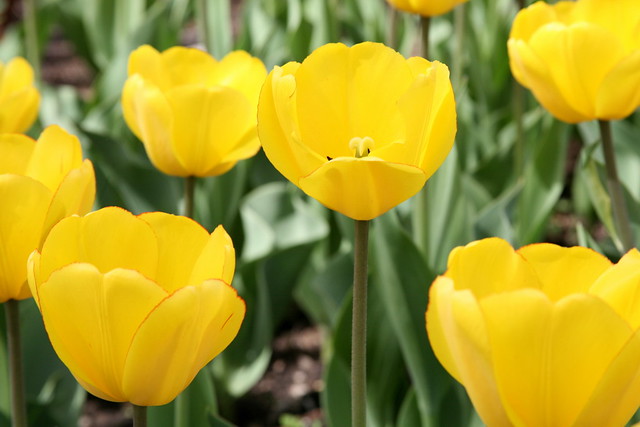
Now I get that tulips are beautiful. Personally I like the solid colors better, especially the yellow ones.
gratuitous yellow tulips
But regardless of color or design, tulips are my favorite flowers. I mean, just look at these. Such vibrant colors! Still, I would never pay thousands of dollars for one bulb.
But then... I'm not a 17th century Dutch investor, am I?
*
[This post brought to you by: "Eeeeeee, tulips!" aka: "I have a shiny new book idea, but I can't work on it yet, so here's some research thinly disguised as a blog post."]
Wednesday, August 13, 2014
A Matter of Degree
I write books.
(No, really? You don't say!)
But that wasn't always the plan. When I started out in college I had no idea what I wanted to do. I studied a whole bunch of math because I was good at it, and when the major I was hoping for fell through, the easiest alternative was to fall back on a math major. I didn't realize I wanted to be a writer until my senior year.
Sometimes I wonder: if I had known then what I know now, what would I have chosen to study?
So, just for fun, here's a (not very well thought out) guide to majoring in "I want to be a fantasy writer."
1.Take lots of English classes. Don't bother taking too many English classes. Unless they sound really interesting, like Beowulf. (Have I ever mentioned I've considered adopting a really ugly cat and naming it Grendel?) Instead, read a lot of fantasy in whatever free time you get.
2. Caveat: take lots of Linguistics. I only really understood English after I studied lots of other languages. (And I do love diagramming sentences. *sigh*)
3. Throw in a good bit of Anthropology. Roll a die to see which courses you get--you can hardly go wrong.
3a. Take an Anthropology of Music class. Music is a kind of magic, right? Decide you would rather be a musician. Drop everything, take piano lessons and become a composer.
3b. Take an Anthropology of Food class. (After all, people love reading long descriptions of every single meal your characters eat, down to the minute details of preparation.) Realize you'll probably be cooking for the rest of your life, so you might as well be good at it. Enroll in culinary school instead.
4. Take a Mythology class for inspiration. Add in some Military Science if you plan to have any warfare in your books.
5. Choose a track: Contemporary, Historical or Other-world Fantasy
5a. Contemporary. Take some introductory Biology, Chemistry and Astronomy. You can't break science with magic until you know how it works!
5b. Historical. Take a bunch of Medieval Studies classes. Come to the conclusion that there are enough Medieval Fantasy stories in the world, and that it was a rather brutish time period anyway. Take several History courses from multiple eras all over the world instead. You'll probably not hit on the one era you end up wanting to write about, but at least you'll know how to do research!
5c. Other-world. Take Economics. Geology. Political Science. Religion. A bit more Anthropology for good measure. Fight the disappointment that slowly dawns on you as you realize no world you design will ever be quite as real as the real world.
6. Add in some Psychology if you still have room for it.
7. Succumb to burn-out. Remember that you used to be so good at math. Wonder if you still might be able to make a career out of it somehow...
In retrospect, maybe my studies, unconventional as they were for a writer, set me along precisely the right path in the end.
(No, really? You don't say!)
But that wasn't always the plan. When I started out in college I had no idea what I wanted to do. I studied a whole bunch of math because I was good at it, and when the major I was hoping for fell through, the easiest alternative was to fall back on a math major. I didn't realize I wanted to be a writer until my senior year.
Sometimes I wonder: if I had known then what I know now, what would I have chosen to study?
So, just for fun, here's a (not very well thought out) guide to majoring in "I want to be a fantasy writer."
1.
2. Caveat: take lots of Linguistics. I only really understood English after I studied lots of other languages. (And I do love diagramming sentences. *sigh*)
3. Throw in a good bit of Anthropology. Roll a die to see which courses you get--you can hardly go wrong.
3a. Take an Anthropology of Music class. Music is a kind of magic, right? Decide you would rather be a musician. Drop everything, take piano lessons and become a composer.
3b. Take an Anthropology of Food class. (After all, people love reading long descriptions of every single meal your characters eat, down to the minute details of preparation.) Realize you'll probably be cooking for the rest of your life, so you might as well be good at it. Enroll in culinary school instead.
4. Take a Mythology class for inspiration. Add in some Military Science if you plan to have any warfare in your books.
5. Choose a track: Contemporary, Historical or Other-world Fantasy
5a. Contemporary. Take some introductory Biology, Chemistry and Astronomy. You can't break science with magic until you know how it works!
5b. Historical. Take a bunch of Medieval Studies classes. Come to the conclusion that there are enough Medieval Fantasy stories in the world, and that it was a rather brutish time period anyway. Take several History courses from multiple eras all over the world instead. You'll probably not hit on the one era you end up wanting to write about, but at least you'll know how to do research!
5c. Other-world. Take Economics. Geology. Political Science. Religion. A bit more Anthropology for good measure. Fight the disappointment that slowly dawns on you as you realize no world you design will ever be quite as real as the real world.
6. Add in some Psychology if you still have room for it.
7. Succumb to burn-out. Remember that you used to be so good at math. Wonder if you still might be able to make a career out of it somehow...
In retrospect, maybe my studies, unconventional as they were for a writer, set me along precisely the right path in the end.
Subscribe to:
Posts (Atom)